


Schools are places where students go to learn and develop as a human for their future career goals and aspirations. However, education has a major role on student mental health.
According to the National Association of School Psychologists, the recommended ratio of school psychologists to students should be 1 to 500. However, in 2023, the actual national ratio of psychologists to students in schools was 1065 to 1.
This is almost double the recommended amount, highlighting the lack of accessibility to mental health support resources. Resulting in many students having a difficult time managing stress, coursework, extracurricular activities, and college applications. This shortage of resources is alarming, due to the major role schools have in managing student well being.
Research from the Mountain Heights Academy shows that schools play a key role in supporting students’ mental health and well-being. When students feel welcomed and connected to their school community, they have improved mental health and academic outcomes.
A healthy school environment can assist students overwhelmed by expectations in and out of the classroom.
These expectations include intense competition around the college application process, as admission officers’ criteria have been rising over the years. Not to mention the high course load from many honors (AP) classes, along with parental expectations for their children to succeed. Research shows that this continued pressure can lead to long term stress.
The weight of the pressure is amplified by the academic workload high school students have. Academic pressure also does not stop with homework, as students balance many extracurricular activities.
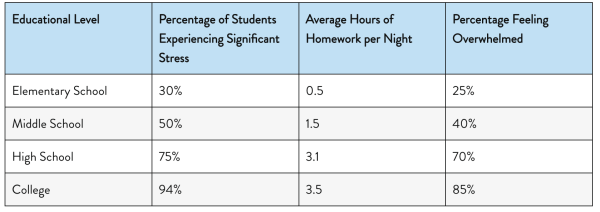
All these factors can trigger anxiety, depression, and burnout among students. In addition, the CDC believes it can foster bad habits of perfectionism and the fear of failure. This leads to over 50% of high school students suffering from stress. “A staggering 74% of students consider homework a source of stress, ranking it just below school grades as a major stressor” an article from the Crown Counseling said.
Homework has sparked debate among educators, as it is argued by the NEA that homework has insignificant benefits when assigned in large quantities. Furthermore, being overscheduled with many extracurriculars can result in students sacrificing sleep, social time, and the ability to develop soft skills.
With the vast majority of students identifying assigned work as a stressor, the impact remains evident. Unfortunately though, the stress accumulated from school stretches beyond the mental.
Sleep deprived and physically fatigued, the issue of student’s mental health becomes detrimental in vast areas of student life. This behavior then extends into student time management and ability to take on responsibilities beyond the classroom.
“The survey data and student responses indicate that spending too much time on homework meant that students were “not meeting their developmental needs or cultivating other critical life skills,” Mollie Galloway from Lewis and Clark College said, “Students were more likely to drop activities, not see friends or family, and not pursue hobbies they enjoy.”
Despite the societal value of academics, the prohibiting and detrimental effects raises the question on the worth in relating to the benefits.
“There was no relationship between the time spent on homework and how much the student enjoyed it. The research quoted students as saying they often do homework they see as “pointless” or “mindless” in order to keep their grades up ‘This kind of busy work, by its very nature, discourages learning and instead promotes doing homework simply to get points’”
However, not all academic challenges are inherently negative for the students. Advanced classes, in particular AP classes, can offer numerous benefits.
According to the Crimson Global Academy, AP classes provide opportunities for college credit, which allows students to save money in the long run in college. This is in addition to critical thinking and problem solving skills that students may not have developed without AP classes. Not to mention soft skills like time management that challenging, yet rewarding AP classes offer.
It is important the student finds a balance. Ultimately, student mental health is carved through academic obligations, school resources, and expectations. The student must consult resources, like school counseling, allowing students to shape their mental health positively.
Joys Kapali is the DP Psychology teacher here at Huron.
“I think it’s worth it for some people and not worth it for others. I think it depends on the perspective the student is taking. I think school can be difficult, especially Huron can be very stressful if the kids only goal is to get good grades and then make their transcript look good for college applications, I think that’s not the correct way of going about an education.”
Kapali states that the course work that students choose or get assigned can really affect their performance in a class. Intrinsic motivation is a large factor that can make or break a student’s execution in a course. If the student enjoys their class they will do well, but the opposite goes for students who don’t find interest in their course. This idea carries over heavily in college and can be amplified by how a teacher runs their class, and Kapali speaks about this from experience.
“I think especially in college, when you’re paying for your classes. I think most people, as you get a little bit older, realize that your professors don’t owe you an interesting class. They’re offering classes that they’re experts in, and you have to get a certain amount of classes to get your degree. Some are really interesting, especially for my psych classes.”
This emphasizes the idea that teachers also play a heavy role in how you feel about your courses. As you get older and especially go to college, teachers see you more as adults than children who need to be amused by the work that they are giving you. This can benefit students by encouraging action on personal responsibility but can also prevent uninterested students from succeeding.
“I found my upper level psych classes were more complicated, more work, and more hours. But I found those to be more interesting than my freshman year classes that were more foundational. But I understand now that getting through those boring foundational classes are really important to actually enjoy and understand upper level classes that are more complex and more interesting.”
This can also apply to students who are even interested in the topic they are majoring in. Many early pre-requisite classes require foundational learning to get students ready for hands-on experiences. Even though this doesn’t entertain them or the idea of what the class is supposed to be, this can ensure that many students are successful in what they want to accomplish.
Overall, it just depends on what the student wants, their goals and their current life’s workload to really test their dedication to a course. Their drive is based on their intrinsic motivation to complete that course. Whether it offers work in the future or just peaks their interests, the student is the main deciding factor, as it’s important students take care of their mental health along with their education.