
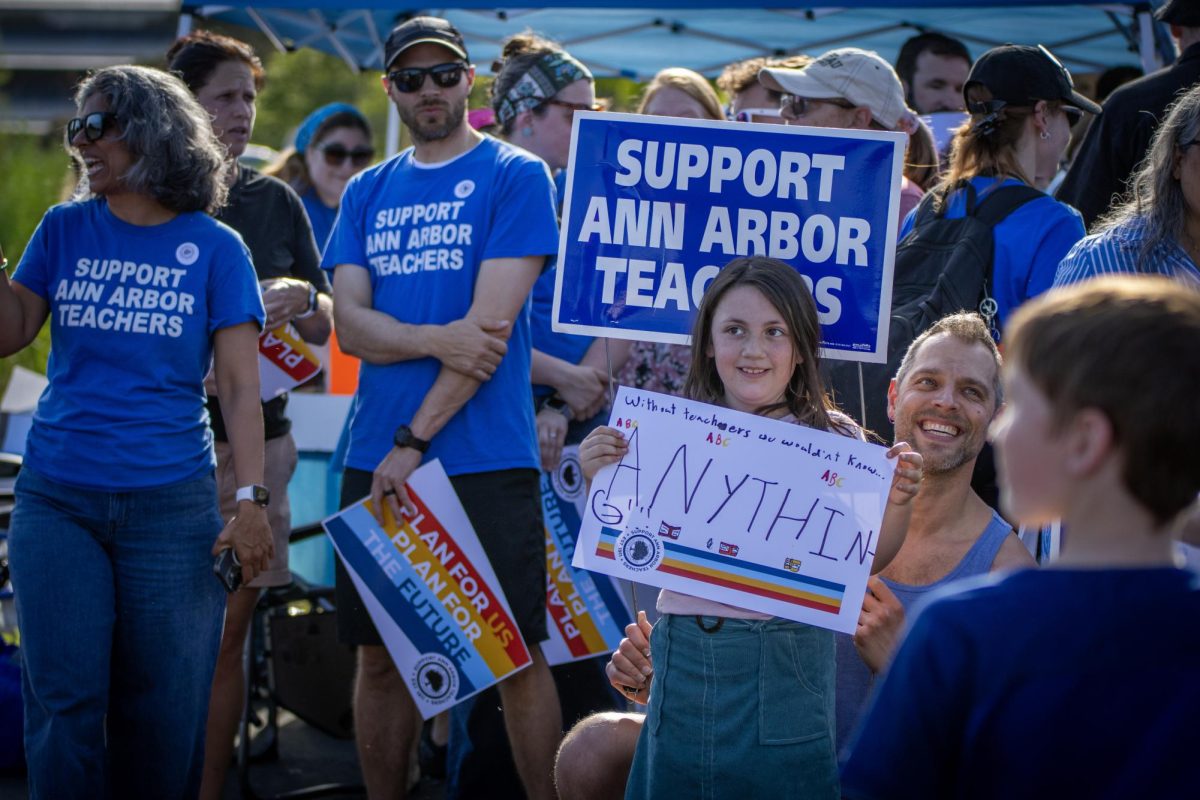
On Wednesday, June 3, 2026, a sea of blue swarmed the outside of the Earhart Administration Building in Ann Arbor, the chants and handmade cardboard signs of over 1500 people filling the air. Ann Arbor Public Schools (AAPS) teachers, with support from students and families, held a rally before the AAPS Board of Education’s meeting.
“It’s an energy unlike any other,” elementary school music teacher Alyissa Amell-Postler said. “This is one of the biggest turnouts I think we’ve had at any of our events. We surpassed a thousand twelve hundred people. It was a big, big turnout, and it was more than just teachers this time, but our community behind us, which was amazing.”
Previously on April 27, the teachers voted against a proposed tentative agreement that would have led to an increase in class sizes, a decrease in planning time for teachers, and a decrease in wage compensation.
In response to the widespread rejection of the tentative agreement, AAPS Superintendent Jazz Parks, in her April 27 superintendent message, emphasized the continuing collaboration and negotiation between the district and the Ann Arbor Education Association (AAEA).
“Ann Arbor Public Schools remains committed to the collective bargaining process and will continue working with the AAEA toward an agreement that supports educators, maintains stability for students and families, and reflects responsible stewardship of district resources,” she said.
Since the vote, the AAEA and the district have not completed negotiations, making June the sixth month AAPS teachers have been working without a contract.
“I hope from this rally that the people that are in charge, that are supposed to be making the decisions, understand that the community is fed up,” vice president of the Michigan Education Association Brett Smith said. “It’s not fair to the parents, it’s not fair to the students, to be in this constant turmoil.”
The two main things the AAEA hopes to fix is the salary compensation and the healthcare cost sharing with the district. In addition to these, however, it also hopes to protect expenses the district proposed to cut, including elementary enrichment classes like physical education and Project Lead the Way through decreasing planning time.
“They were looking to cut some things that we feel are very valuable for our students,” AAEA President Fred Klein said. “We feel like it’s our duty to fight for students to preserve that essential instructional time, because that’s an area where many of our students experience their most success, they love those classes, and we don’t want to see those diminished and go away.”
After the rally, the AAPS Board of Education began 15 minutes late due to overcrowding in the room leading with a public commentary session where community members could share their opinion on the issues on the agenda, mainly the new budget proposal and the effects on teachers’ salaries.
“We already tried doing a teacher pay cut,” said Aaron Wolf, the father of two students at Wines Elementary. “We tried that in 2024. And because that was not the problem, we are back here again. We can’t do it again. We can’t keep trying the same thing and expect a new result. We have to address the actual problem. The actual problem is the growth in transportation costs, the growth in supplies and textbooks, the growth in software spending.”
A main argument throughout the public commentary session centered around transparency within the district’s spending. Some proposed a Citizens Financial Advisory Committee as a solution.
“At the very least, they could supply another set of hands and eyes on our financial challenges,” AAPS parent Angela Prince said. “There are people with the right skill sets in this room ready to volunteer and do the work. The pieces are in place. It’s just a matter of putting them together. Let’s get back to educating our kids, and let’s pay our teachers.”
During the budget briefing, AAPS Chief Financial Officer Anté Britten overviewed the budget proposal for the 2026-2027 fiscal year, mentioning a planned but not guaranteed increase in staff payroll. Britten and the Board of Education emphasized the increasing transportation and health care costs as main contributors to the district’s current financial difficulties. In his presentation, Britten described a few recommendations to maintain a healthy reserve balance for the district, including consolidating schools and programming and collaborating with unions to right-size staffing.
“We can’t cut busing for our school students,” Britten said. “We can’t cut custodial [services] all the way… Really, the focus here is working with our union. We want to invest in our teachers, but we need to make some changes in order to have that happen.”
The board room was overflowing with people who showed up to support the AAPS teachers, the crowd packed and the claps thundering throughout the area.
“I hope that the giant presence here will show people how important it is to this community that the Ann Arbor teachers get a fair and equitable contract,” Klein said.
On Monday, June 15, 2026, the AAEA plans to return to the bargaining table with the district and continue the negotiation for a fair contract.