
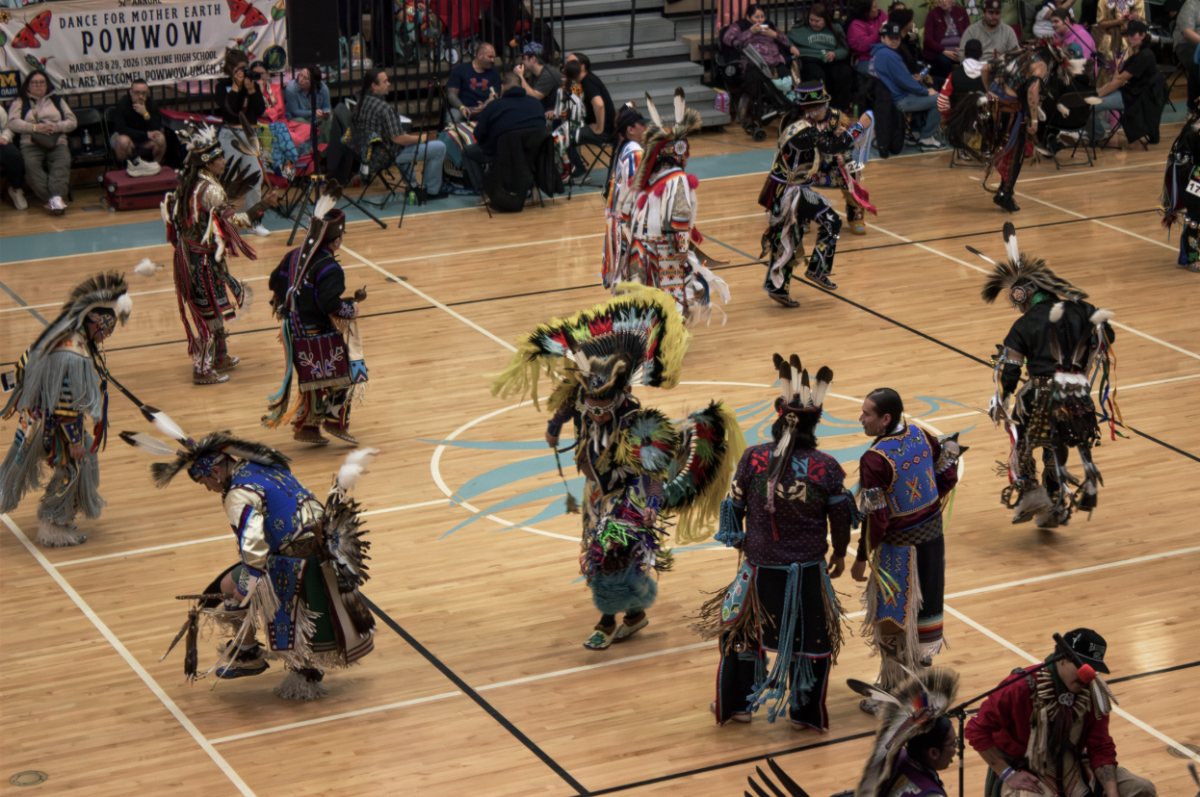
On March 28, hundreds of people gathered in the gymnasium of Skyline High School, packing the bleachers from top to bottom with eager attendees. On this day, however, they were not there to watch a game or root for a specific team. Instead, they were there to celebrate.
The annual Dance for Mother Earth Powwow, now in its 52nd year, is one of the largest student-run powwows in the country. It is organized by the Native American Student Association (NASA) at the University of Michigan and is hosted locally in Ann Arbor.
“It’s a really good way to stay in community,” said Sarah Allen, a master’s student and three-year member of the NASA planning committee. “Especially at a big institution where there aren’t that many Native people. Being around a bunch of students, hearing the drums, it’s very comforting. Especially in a predominantly white institution like [University of] Michigan.”
Patricia Brewer, a member of the Little Traverse Bay Band of Odawa Indians, has been coming to this powwow since she was eight years old.
“This was the first powwow I ever danced at,” she said. “That’s what really was my first exposure to Powwow dancing.”
Since then, Brewer had taken an extended break from dancing in the circle. But this year, she finds herself returning to dance at the very same event that introduced her thirty-five years ago.
During powwows, dancers often wear a collection of culturally significant items; this attire is called regalia. Brewer’s regalia belonged to her aunt. Wearing it, she says, is an act of honoring and her way of carrying someone forward.
“She used to tell me about how much she enjoyed watching me dance,” she said. “It’s an ode to her and how much she meant to me. And it’s an honor to be able to wear her regalia.”
Powwows, Brewer explains, were originally social gatherings. They were an opportunity for families and communities to reunite despite the distance between them. For Brewer, this origin still rings true. She sees relatives at her tribal powwow in northern Michigan that she otherwise wouldn’t have.
“It’s almost like a mini family reunion,” she said.
But the Ann Arbor powwow shows her something especially important: younger generations, Native and non-Native alike, showing up and witnessing Indigenous culture and tradition.
“Society has really picked and chosen aspects of our culture, misrepresented it,” Brewer said. “So it’s nice to be able to show, from an authentic Indigenous perspective, this is who we are. This is what we represent. From our interpretation, not someone else’s misinterpretation.”
For both Brewer and Allen, the powwow is a symbol of cultural pride. It is deeper than a performance; it is a way for Natives to honor themselves and each other, and the presence of an audience is simply an invitation to witness this celebration.