
In 2026, everyone is Chinese. All across social media, users are using the phrase “you met me at a very Chinese time in my life” while doing what they perceive as Chinese, featuring an array of activities ranging in their degree of “Chinese-ness” — whether that is using Chinese herbal medicine, buying Costco crates of fruit, or even drinking hot water.
As a second-generation Chinese-American, watching this trend emerge has felt like whiplash. The U.S. has had an incredibly complicated past with Chinese people, and there is a history of anti-Chinese sentiment that has existed in society for decades and still does today.
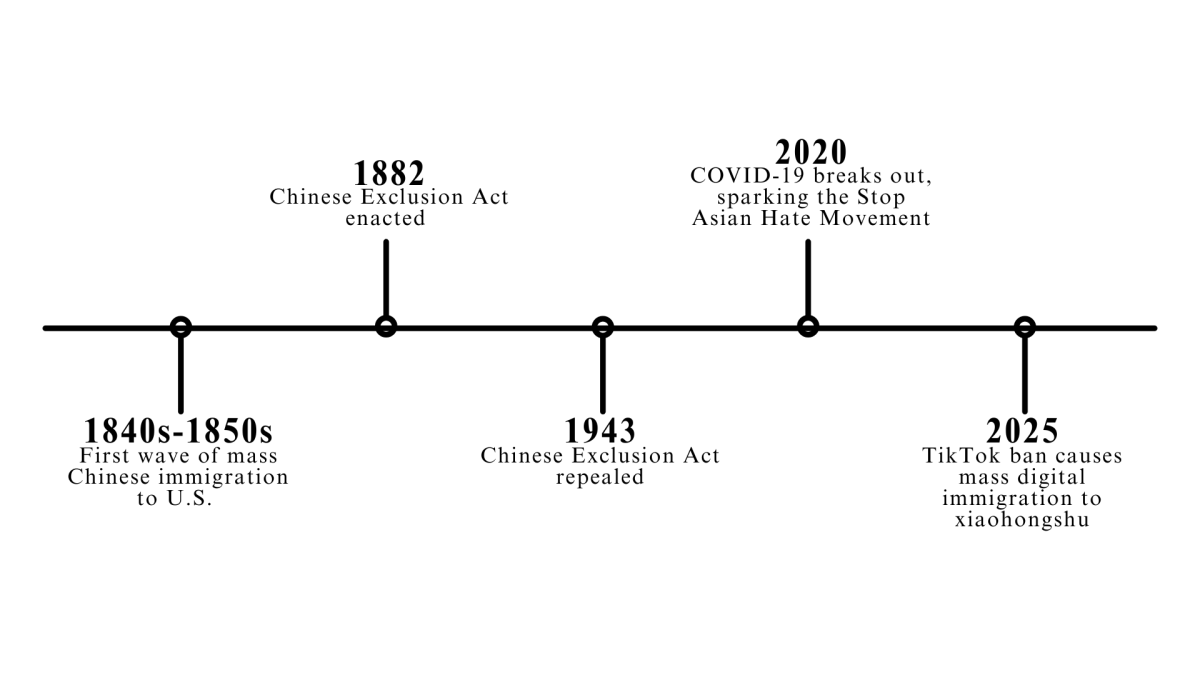
The first wave of Chinese immigration began in the early 19th century, with some arriving in the U.S. to chase the gold rush in California or as contracted workers working on the transcontinental railroad. While immigration increased across America, a land that prides itself on “All-American” patriotism, xenophobia did as well. This culminated in the Chinese Exclusion Act of 1882 — the first immigration restriction based purely on race — and didn’t permit all Chinese immigrants from entering the U.S. until more than half a decade later.
Although the Act was passed more than a century ago, anti-Chinese sentiment in the U.S. is far from gone. In March of 2020, COVID-19 broke out across the world. What began as a two-week vacation from work or school soon transformed into a period of extreme uncertainty, violence, and quarantine. The virus originated in Wuhan, China, and soon Chinese-Americans, and consequently other East-Asians, became scapegoats for the pandemic.
Yet in recent years, pro-Chinese sentiment has seen a surprisingly large increase. When TikTok was banned for a short amount of time, many users found themselves flocking to a Chinese social media app in anticipation: Xiaohongshu or RedNote. Named after communist leader Mao Zedong’s “little red book,” Xiaohongshu is an undeniably Chinese platform and almost completely dominated by Chinese citizens. The TikTok exodus to Xiaohongshu was positive in a way that it allowed many American users to actually interact with other Chinese people in an earnest way. Amidst an ocean of anti-Chinese propaganda, users found themselves changing their perspectives and unlearning negative ideology.
Then enter this year’s “You met me at a very Chinese time in my life” trend. When it was less mainstream, I was able to appreciate the joke for what it was — a satirical statement on typically “Chinese” behavior, including avoiding cold water, wearing slippers at home, and eating noodles. Yet at the same time, I find it strange that we’re treating an entire ethnicity as a coat that we can shrug off when it doesn’t fit anymore. What can be seen as just a “silly little trend” also downplays the nuance around what it means to be Chinese, and more than a century of intense, complicated history.
The truth is that Chinese-Americans do not have that ability to try on our ethnicity when it’s convenient. I will be Chinese-American my whole life. It’s more than hot water and noodles — it means reading Chinese books translated into English, knowing a word in Chinese but struggling to find the words to say it, and visiting my grandparents during hot Beijing summers, wishing for just a little bit more time.
What it means to be Chinese-American is so much more than what “you met me at a very Chinese time in my life” conveys. Still, even if it is through a temporary trend, I hope that some value comes of it. I hope that people can find a genuine appreciation for another culture, because we need more of that today.