


As winter winds down and spring approaches, we all know that there is at least one thing we need to worry about. The flu season.
With the 1918 flu pandemic being the worst pandemic of its kind, the influenza virus that caused the outbreak continued to evolve over time, eventually becoming the less lethal viruses we call the “seasonal flu” today.
However, researchers and doctors discovered that the 2025-2026 flu season might be the worst episode in several decades.
“[The flu season typically] comes in the winter months in cold dry air and it typically peaks in January and February,” Adrienne Musci, a doctor of the General Pediatrics East Ann Arbor Health and Geriatrics Center, said. “[However,] I don’t remember seeing influenza be this early and this widespread.”
Musci isn’t the only doctor who finds the flu pandemic occurring earlier than usual.
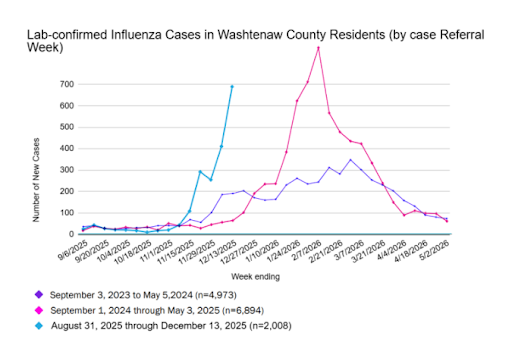
According to the Health Department of Washtenaw County, the flu season this year is spiking earlier than the past three years.
It was recently reported that a new mutated version of the Influenza A H3N2 strain called “subclade K” is on the rise internationally (The BMJ). Subclade K is considered to be highly infectious, causing the early flu spike in many countries. However, many scientists think that the infectiousness is not caused by the virus strain itself, but because people do not have immunity against this new strain.
Interestingly, in Ann Arbor and Washtenaw County, the most common and dangerous type of flu is Influenza B. According to the Wigginton-Eisenberg Laboratory, Influenza B level was very high in Washtenaw county wastewater system as of Dec 21, 2025, while influenza A level was modest. Therefore, while Influenza A and subclade K are the most popular flu variations nationally and internationally, locally (here in Ann Arbor), Influenza B is the most common strain.
Musci also said that most of her Ann Arbor pediatrics flu patients had Influenza B.
“I don’t know why there is increased influenza B this year.” Musci said.
Huron High School and Ann Arbor Public Schools (AAPS) were also hit hard by flu-like symptoms.
“I do notice at times that we are getting more students coming in feeling ill, having fevers [and students] that want to go home,” Huron’s school nurse Patrice Gage said. “And that was right before Christmas break. We were very busy that week before Christmas break, not only my school, but all the schools [in] Ann Arbor Public Schools hitting a rapid increase in [absences] of sick students.”
Symptoms of influenza typically appear within one to four days after being infected.
“The symptoms of flu are [a] variety,” Gage said. “Starting out with feeling feverish, body aches, sore throat, headache, cough, those are some of the symptoms of flu, and it can also be symptoms of other things like COVID-19 or just your common cold. It is only when they go home and if they seek treatment at their doctors, and you get swabbed, and they will tell you if you are positive for flu.”
Gage says that handwashing is essential to prevent the flu virus from spreading. She says that when we cough or sneeze, tiny germ particles land on our hands and those germs can contain the flu virus. Washing your hands, as Gage says, can prevent the virus in your hands from spreading to someone else.
“I just really want to stress to students that they can help keep themselves healthy, healthy by simple things,” Gage said. “And these are not things that will be too hard on them, like hand washing and getting good sleep. Students should be getting, at this age, at least eight to ten hours of sleep a night. They should [also] be drinking lots of water and eating good, healthy foods, and they will notice a change if they just try to just tweak some of these things in their life.”
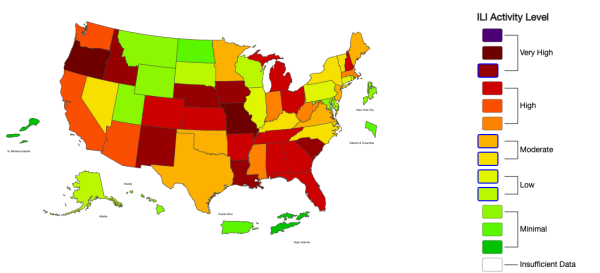
Ann Arbor and Huron High School were already hit hard by Influenza B before Christmas, which was quite bad. Unfortunately, Influenza A and B are different viruses, and people who had Influenza B might get Influenza A from the same season. Because the new mutated strain of Influenza A, Subclade K, is on the rise nationally, it may arrive in Ann Arbor sooner or later, causing another outbreak of flu. That’s why we are heading to the worst flu season in a decade. Still, by having good sleep, lots of water and eating well, we may be able to protect ourselves from the flu in the remaining winter.
“Get vaccinated against the flu,” Jazz Parks, superintendent of AAPS, said. “Vaccination is recommended for all children and adults without contraindications starting at 6 months of age. The flu vaccine reduces risk of infection and protects against severe illness.