
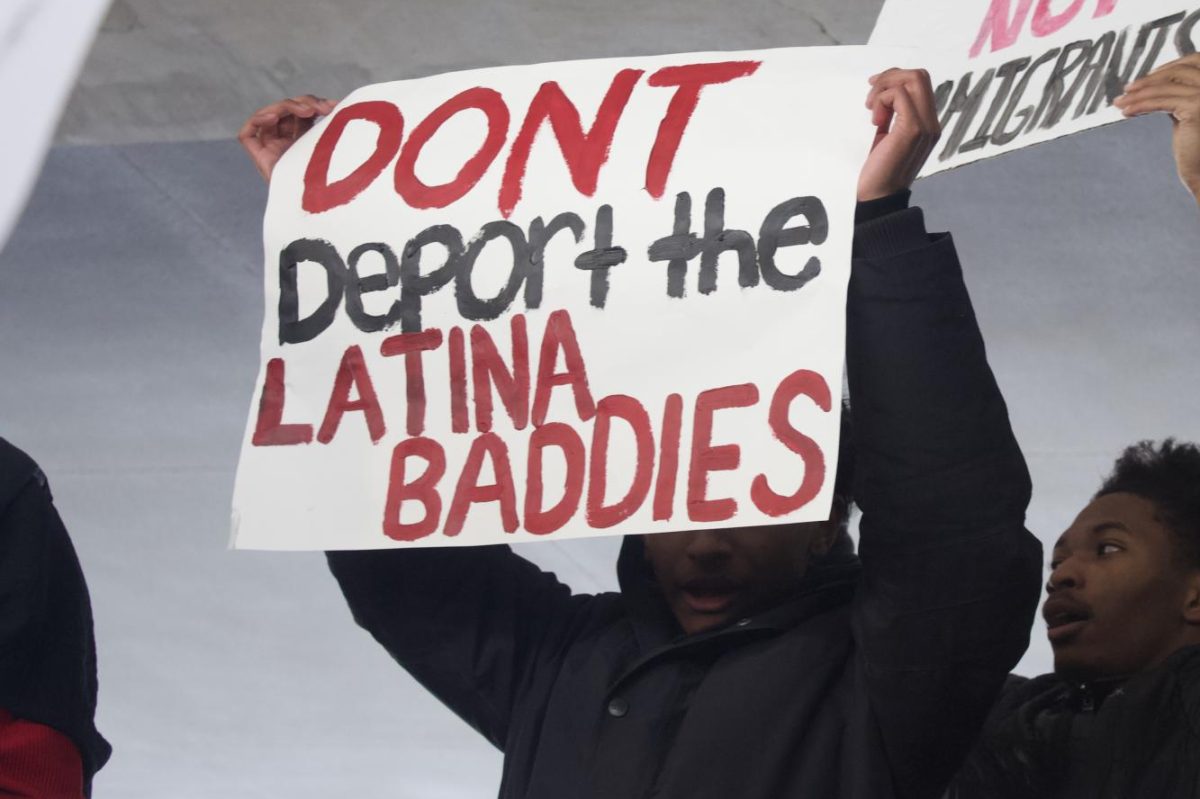
This past Wednesday, Huron’s student body walked out of their fifth hour in protest against Immigration and Customs Enforcement (ICE). Students congregated under the arch as a selection of students from various student organizations spoke. Or at least, attempted to speak. The noise from the bundled-up crowd was energized and anything but attentive. Emotional stories were pitted against the voices of hundreds of restless high school students, all of whom were egged on by the unserious energy of their peers.
The reaction from the student body can be attributed to many things, but one of the most prominent is the role of social media. We all hold undeniable levels of power; the use of our cellphones offers us a heightened awareness of those around us and the hardships they face. Social media is consistently used as a means of organizing, allowing things such as strikes and protests to gain traction organically. Unfortunately, social media also forces us to be extremely aware of outward appearances. Which begs the question, can we show up in spaces with a genuine intent? Every time we post, we are asked to create and maintain a persona; the digital world provides us with the tools, the following, and the stage to perform. More often than not, this creates a paradox of keeping up appearances holding more weight than real-life action.
The lack of attention given to the speakers on the given day was seemingly mitigated by the influx of posts put up about it soon after. It appeared that very little care was given to the situation in the moment, but participants were quick to grab pictures as proof of their presence, justify skipping a class, and feel righteous in their (albeit limited) involvement.
It is getting increasingly hard to see where genuine care ends and mindless engagement starts. The attention and importance we give to things we see online are very limited. Social issues become fleeting trends at least, and memes at worst. Too many of the things we say and do online are subject to inordinate amounts of irony. Dark humor has found a home in pockets online and is often used to cope in these times of hardship. But when pulled off the screen and pushed into real life, this humor is not read the same way. This blurred line translates to the behavior exhibited at these types of high school-level demonstrations. Without a screen between people, this is insensitive and ignorant commentary on an emotionally charged issue.
Students at Wednesday’s demonstration held signs with taglines that have gained traction on TikTok for their unseriousness. But what do we gain from not taking things seriously? As students, what we say and do holds a lot more importance than we seem to realize; at a certain point, we need to stop taking it for granted. Now that we have this stage, what we do on it has more impact than we can possibly imagine. It is necessary for us to take action that is tangible and do so with dignity and respect. Call your representatives, donate what you can, and above all, make sure that your activism is not limited to a performance.
_________________________________________________________________________
The district has been provided “Know Your Rights” materials to support and share with immigrant families as needed. The National Immigration Law Center suggests the following if you come in contact with ICE:
- Remain silent
- Use a Know Your Rights card, which states, “I am exercising my constitutional rights under the 4th and 5th amendment.”
- Do not sign any documents without consulting a lawyer
More information on Know Your Rights from the National Immigrant Justice Center, with links and resources to detainee locators and valid warrant examples, can be found here.