
Exchanging cultures, experiences, and moments
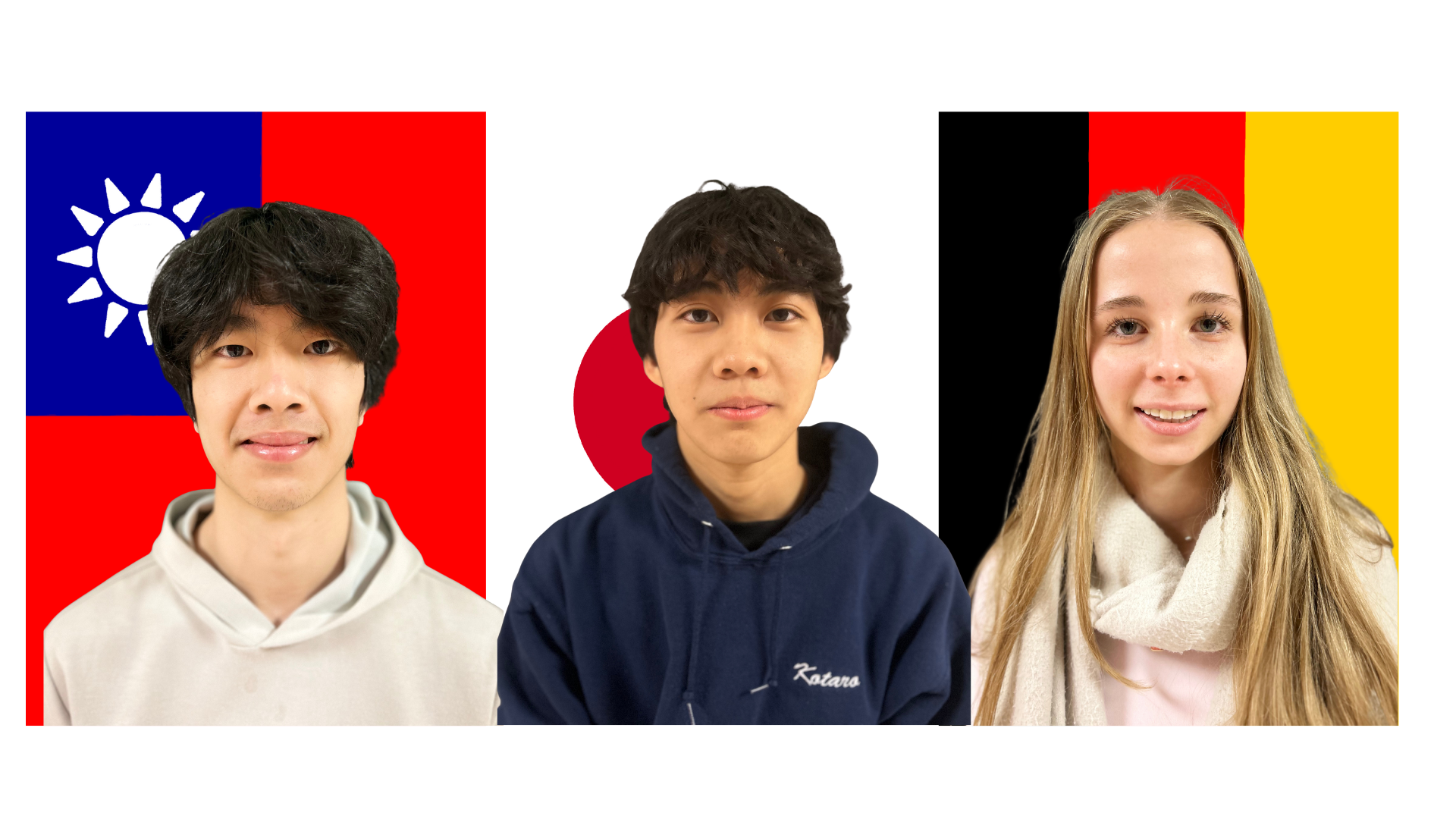
After a plane ride from Washington and Taiwan, junior Ivan Wu had arms full with a passport and luggage in Michigan. It was only as he was having his passport checked by customs officers when Wu finally saw a light, fluffy snow confetti flurrying outside.
“At first, I didn’t feel anything. It was just amazement,” Wu said. “But then when we got out of the airport and me and my dad got into a van, I was actually like, ‘the snow was touching me.’”
Wu had seen — touched — snow before. Prior to his transition from summer Taiwan to winter Michigan, he had been skiing in northern Japan with his mom on the mountains at least five times. But in America, the snow meant something more significant to Wu.
“It’s the country I’ve been seeing in movies and on social media,” Wu said. “It’s like I’m actually here.”
That was on Jan. 22, 2025. On the behalf of his dad’s research at the University of Michigan, he will be returning to Taiwan, to his international school, where it rarely snows from high temperatures on Jan. 17, 2026.
In 2022, during her eighth-grade year, junior Anna Helming, an exchange student from Munich, Germany, was a part of a week-long exchange program with a private girls’ school in Oxford, England.
“I really liked getting a new kind of angle of the culture,” Helming said.
While she enjoyed her time in Oxford, she felt that one week wasn’t enough.
“[One week] wasn’t enough time to experience everything and really get to know the people there,” Helming said. “So I got the idea, why not just do one year abroad?”
Like Wu, she grew up watching American movies and shows, from “Wizards of Waverly Palace” to “Vampire Diaries,” and immediately thought of the U.S.
“And then, of course, the movies,” Helming said. “Because you want to know if [America] is really like all of the high school movies. And I was like, let’s just do it.”
After a long flight from Munich to Detroit with barely any sleep, Helming was a bundle of nerves.
“It was scary,” Helming said. “I mean, I was scared that [my host family] wasn’t gonna like me or something, or it was gonna get weird.”
But as soon as she stepped out, her worries immediately dissipated.
“My host mom had her phone out to film, and they made this poster [that said] welcome to the U.S,” Helming said. “It was good.”
Upon meeting, Helming’s host brother, who is six years old, was shy at first. But on the drive back home, he began to warm up and “talk non-stop about Pokémon.”
Since then, the two have built an inseparable bond — almost like blood related siblings.
“I would just say watching the interaction between Anna and our son, especially,” said Erin Sprute, Helming’s host mother. “I think it’s very tender…it’s a very natural pushback, or balance, that the two of them have.”
Helming and the Sprutes did not through an exchange program, but rather through a third source: Helming’s neighbors in Munich, who had moved back to Ann Arbor and happened to be acquainted with the Sprutes.
Helming had mentioned that she wanted to stay in the U.S. as an exchange student, and her neighbors helped to set up a profile through Ann Arbor’s local German school in order to find a host family.
“There was a little bio about her…a picture, and she looked like a darling girl,” Sprute said. “And I was just like, this could be lovely.”
Helming hasn’t had any issues settling in with the Sprutes, due to various reasons. Helming’s host father, Holger Sprute, is German, the Sprutes also previously hosted two German boys last year, and they’ve lived across the world, from China to Mexico.
But most importantly of all, the Sprutes and Helming seem to just “click.”
“She fits our family like a glove, really,” Sprute said. “I never would have considered adopting a teenager until I met Anna. If we could keep her forever, we would, but obviously, she has a family she needs to return to.”
Most of all, Helming has learned some valuable lessons. “[I’ve learned] definitely that communication is key, and that you just have to put yourself out there and do stuff,” Helming said. “Just don’t be scared of new experiences, like making new friends or the first day of school…in the end, no one cares really. Just live your life.”
On the northern Japanese mountains Wu once skied on before his transition to Michigan’s Mount Holly and Brighton, Kotaro Hiroe, senior exchange student from Japan, climbed the scapes of such cliffs. He finds it the most contrasting geographical feature from Ann Arbor.
“I was surprised by [how] Ann Arbor is flat,” Hiroe said.
Hiroe had to begin school four weeks after its commencement as he was challenged when acquiring his visa. It was only after he received his interview at the embassy, was his visa granted for him to exchange in the U.S.
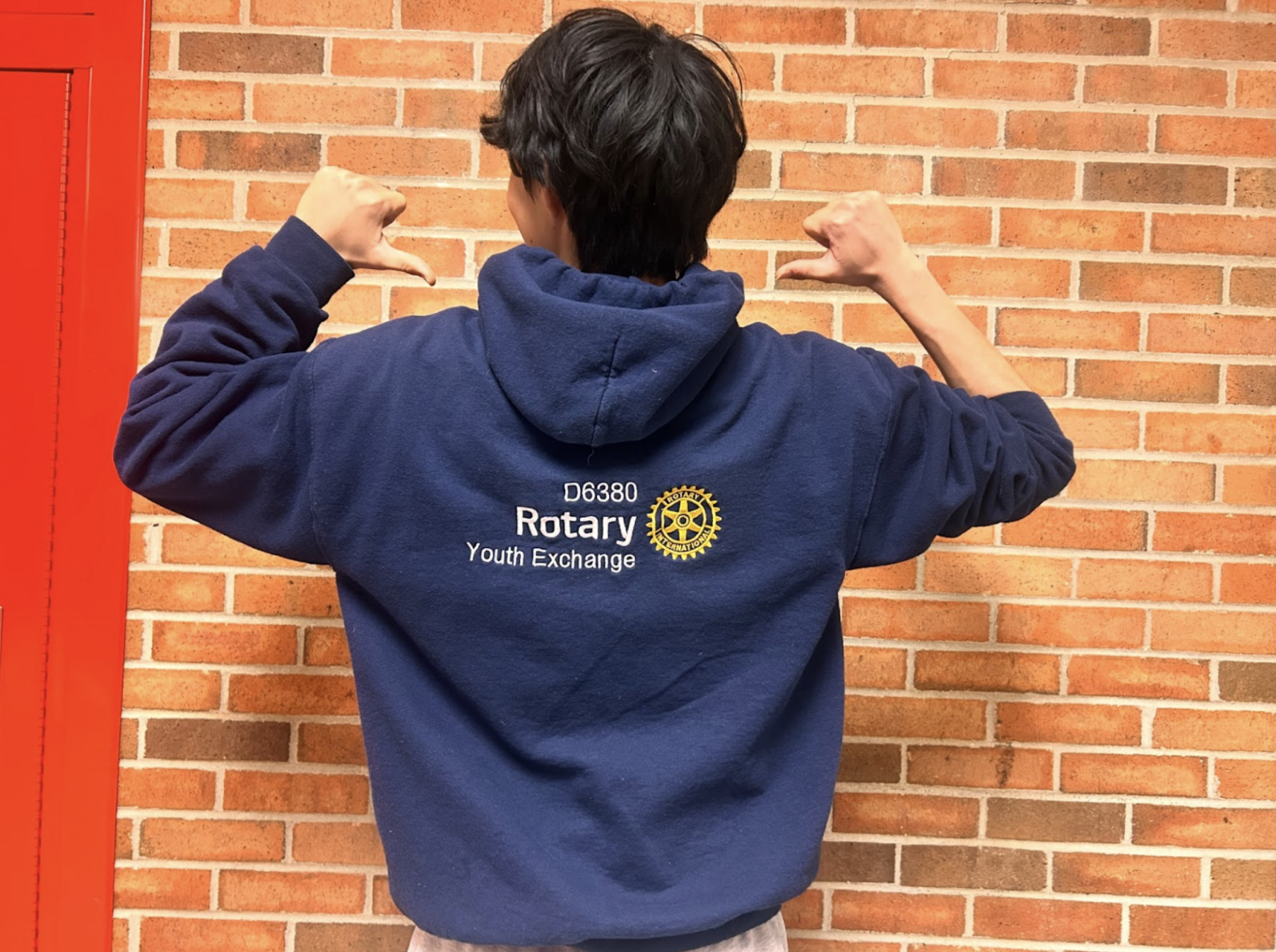
Hiroe arrived in Ann Arbor on Sept. 18, 2025, with the Rotary Youth Exchange program.
The only words he knew were “probably” and “definitely.”
“When I came here, I couldn’t speak English well,” Hiroe said. “My accent is Japanese and U.S. accent is all different. I’ve been living in Japan for 18 years, English is so hard for me.”
A 14 hour plane ride from Ann Arbor, Hiroe originally lived in the Gifu Prefecture of Japan, where he hopes to become a language teacher.
“I have a passion to study English to speak with other people,” Hiroe said. “When I speak English well, I’m so happy. I could go to new place, I’m so happy. I can play basketball here, I’m so happy. When I ate pizza, I’m so happy. A lot of things make me happy.”
After Hiroe returns to Japan on July 29, 2026, he plans on returning to America as an exchange student again from a Japanese university, where he will continue studying the dialects.
“I want to do many things,” Hiroe said. “I want to go to other states, I want to eat other food, I want to sight-see.”
Through the end of a cul-de-sac, Nick and Mary Avrakotos cleared the upstairs bedroom of their house, where Mary once had her coffee and reading morning assemblies. Nick jokingly dubs it as her “Fortress of Solitaire.”
However, it is now Hiroe’s bedroom and Mary uprooted her reading den to a lower level of the house.
“We have another room downstairs,” Mary said. “But we didn’t want you to feel like you [Hiroe] were out of [the home]. If we put you down there, we’d never see you.”
The Avrakotos joined the Ann Arbor Rotary club 14 years ago, when they moved to Ann Arbor. Where they previously lived, Oswego, New York, they were also members of the relative Rotary club there.
Rotary is an international organization that helps to act on worldwide issues. The initiative is divided into different subsections, with Rotary districts across most domains of the globe. Within the districts, there are clubs. For the district the Ann Arbor club resides in, there are 12 to 15 clubs total. Huron is even involved with Rotary, having a dormant Rotaract Club itself.
“A lot of times, some of the issues can be finding host families,” Perko said. “That family is completely responsible for that student, financially and everything else, usually. And I know that there’s sometimes an issue finding host families willing to do that.
To become a host family in the Rotary Youth Exchange program, it requires a family to be vetted. There is an interview process and background checks to guarantee the student is arriving into an eased environment.
“I’ve come to really appreciate Kotaro and who he is. He really is a very positive person and a very welcome addition,” Mary said. “It’s odd because we are older than his grandparents, so it’s interesting to be parenting again after so many years.”
They’re not beginners to being a host family. In conjunction with joining the Ann Arbor Rotary club 14 years ago, the Avrakotos were also host to an exchange student from Venezuela and had a son who was also a participant of the Rotary Youth Exchange program.
Their experiences with foreign collaborations were memorable enough for them to return to hosting again with Hiroe. In fact, the Avrakotos still remain in contact with the Venezuelan student and are already organizing trips to visit Hiroe in Japan.
In Nina Perko’s 22-year counseling experience, she has only had one to two students be successful in their student exchange pursuits from Michigan to another country. There are specific graduation requirements that differ from institution to exchange program, and the application of credits can be translated differently into another system.
“Huron does not have the strongest exchange program,” Perko said. “It’s a lot of work to get the application and to get everything in order to go study someplace else.”
For example, Huron requires a U.S. History credit, while a school in Canada may not necessitate that requisite.
Additionally, the calendar year can act differently in different countries. An exchange student may need to depart from or return to Huron during an ongoing semester, affecting the course of how their credits may sum up to qualify for graduation.
In high school, Perko was a host family to a French exchange student. During her time with them, Perko established some takeaways: she did not know French as well as her French class would indicate, and that she wanted to travel abroad herself.
“It was really, really unique,” Perko said. “That person lives with you, like a sister or a brother, and you get that kind of in-depth experience, learning from them about their culture.”
When researching for colleges to attend, Perko had pinpointed precisely to Aquinas College in Grand Rapids, based on her desire for its Ireland exchange program.
“I knew that I wanted to do a study abroad program partly because of having that exchange student,” Perko said. “I really wanted that particular program.”
Four months in Europe in Perko’s final semester of college, of quaint cottages in a rural portion of Ireland of scheduled day-trips is where Perko centered the most of her maturity in one of her first times traveling independently.
“There’s a different level of responsibility and a different level of maturity you have to have,” Perko said. “Coincidentally, my parents said when I came back that they thought I had matured quite a bit. They were really glad that I had that opportunity because they saw a change in me.”
Quite often, exchange programs are where the most firsts can happen for the student. Wu’s first snow, Perko’s first voyage of maturity and Hiroe’s first time in America.
For Huron students interested in attending an exchange program, the ultimate factor of a productive cultural exchange is planning. If a student is considering a semester abroad in their junior year, regarding all steps of the exchange procedure is encouraged to begin as preliminary as middle school.
“The more advanced planning they do, the better,” Perko said.
To become accepted for an exchange program it can involve paperwork, applying for various visas, receiving specific vaccinations. This can take six-months to a year for successful completion.
“It really depends on the student and where they’re at, where they’re looking at going, their maturity and kind of their plans,” Perko said. “I would say junior year is probably a good year.”
There is a correlation between upperclassmen and exchange students: Helming and Wu are both juniors, while Hiroe is a senior.
There are exceptions. If a student is planning to do the entire IB Diploma Programme (DP) at Huron, junior and senior year would not be a feasible option as DP classes are taken during both those years. However, summers pose an alternative for those committed to immersion in another country, without the sacrifice of curricular and extracurricular activities.
Ann Arbor Public Schools (AAPS) has designated a list of suggested exchange programs students can personally research and decide from if following the exchange route, which can be accessed here.
“I just say, Google it and see what you know. Look at the different programs and look at what’s going to be right for the student,” Perko said. “The Ann Arbor Schools does have a long list of suggestions, because it’s really on the students.”
Perko is an advocate for foreign exchange students to submerge in new pastimes — try out for the water polo team or join the chess club to find familiarity with Huron’s own culture.
“Generally the point is, they’re coming to immerse themselves and learn about the culture and learn what it’s like living here,” Perko said. “We encourage students to get as actively involved as they can so that they get the best experience.”
On Nov. 16, Wu had his final water polo game against their rival Pioneer.
“The game was over before I knew it,” Wu said. “It’s the last time we get to play water polo together.”
During Huron’s orientation, Wu promptly had the water polo kiosk hub in his vision, a captain and parent standing by its sides.
“I don’t know why, but I just noticed their sign,” Wu said.
Wu signed up with his email and was contacted to participate in the off-season, passing the ball and scrimmaging, before officially uniting in the fall season.
“I encourage students to get out there and travel and experience new things,” Perko said.
Sometimes, for an exchange student, being in a new and culturally contrasting setting means not starting, but strengthening the passions that have always been there.
Hiroe learned basketball from his dad, a mentor of the game and member of Rotary, three years ago. Basketball has enveloped itself into gym, his favorite class, and Luka Dončić, his favorite basketball player.
In the Health and Fitness Center at Washtenaw Community, every Tuesday and Thursday, Hiroe plays like Dončić among his older peers.
“Kotaro plays basketball twice a week,” Mary said. “He’s learned how to trash talk over there, learning so many American virtues.”
An exchange program is the communication between cultures. The squeak of sneakers between Hiroe’s love of basketball in Japan and Washtenaw’s Fitness Center. The sound of Helming having a conversation with her classmates on the first day of school.
“Communication is kind of key. You just have to put yourself out there and do stuff because nobody’s gonna care,” Helming said. “Don’t be scared of new experiences. Just live your life.”
It’s the sound of flipping a passport’s pages and learning a new word. It’s the sound of snow falling around Wu.
“Programs like this are really important in fostering cross-cultural understanding and communication. And we don’t have enough of that in our world,” Mary said. “It’s life-changing.”
Your contribution will support the student journalists of Huron High School, help us to offer scholarships, cover our annual website hosting costs, and most importantly, allow us to keep recording history.