
The uptick of students with free hours at Huron


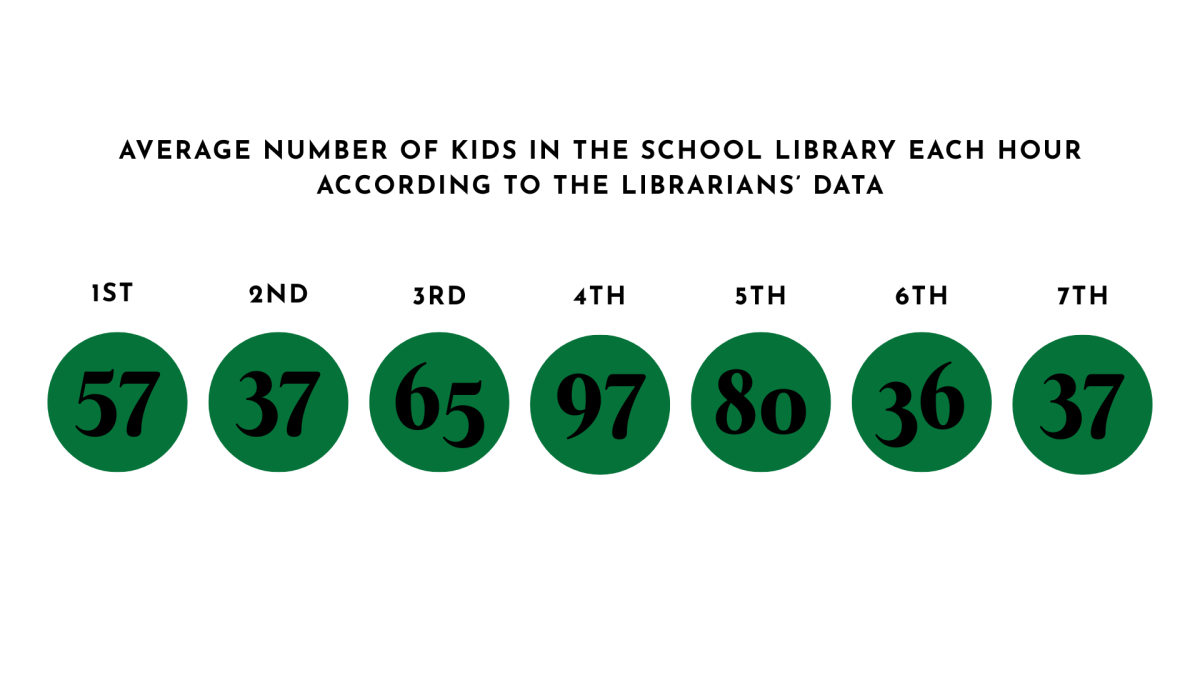
The Huron media center is the designated location for students who do not have an in-person class. This means that the library is often very populated during the school day.
The number of students who spend at least one hour in the library has been growing each semester.
One factor that dictates numbers of open hours is when departments have collaboration hours. The English team’s hour off is fifth hour, meaning that no student can take an English class fifth hour. Counselors have to work around that when creating the schedules for students.
“Supervision of open hour students is becoming a growing responsibility in this space,” librarian Caroline Hughes said.
Librarians are spending more time writing passes, helping with resource collection and managing students, which allows for less time to do other administrative and organizational tasks that also need to be done.
The library can also be distracting for many students.
“It’s normal developmentally for students to want to socially connect with each other,” Hughes said. “I celebrate that, but I think there’s also a time and a place for everything.”
Some students who live within walking distance or drive opt to go home early or come late if their free hours line up that way.
Desai walks home after spending late lunch with her friends because she feels more efficient at home.
“I’m the type of person who just likes to be alone for studying,” Desai said. “If I’m at the library, I’ll just go on my phone or talk.”
Hughes said she feels sad that having so many students might negatively impact her ability to have positive relationships with them.
“Education will always continue to evolve and change, and that’s a good thing, but I think it’s important we be intentional about it,” she said.
The 249 students enrolled in a virtual class at Huron take 370 online classes overall. These are through both A2Virtual+, Ann Arbor’s online learning program, as well as Michigan Virtual, an external platform through the state that AAPS pays for.
There are 1211 students enrolled in an online class throughout Ann Arbor Public Schools, and 1640 classes running.
“The numbers are huge,” said Jennifer Durell, Huron A2 Virtual+ Building Liaison and Michigan Virtual mentor. “It’s the biggest it’s ever been.”
The other Building Liaison, Elliot Wills-Begley said that although it is necessary to have interpersonal connections at school, having an online learning option allows students to get through class content in a straightforward manner.
“Having the entire school day be so socially stimulating can be really overwhelming,” Wills-Begley said.
This year, level four and AP world languages were cut, which made some students turn to the DP option and others to online learning for those classes.
The AP teachers recommended to as many students as possible to take the DP in-person option.
“In a language class, because so much of it is listening and speaking and interaction, students are just not getting the languages in our online classes,” said Ellen Schultz, former AP Spanish teacher who now teaches DP Spanish and Spanish III at Huron.
Chinese teacher Fan Wu is in a similar position. She used to teach Chinese IV and AP Chinese, and now teaches Chinese levels I, II, III and IV. She said that the AP track should not have been cut from world languages.
“It is not good for students,” Wu said. “In the DP standard level, no college gives credits, but in AP Chinese, they can at least have the chance to get credit.”
Wu said that cutting level IV and AP world languages doesn’t guarantee an increase in DP world language enrollment because students can choose to take those classes through Michigan Virtual.
“Under the School of Choice policy, Huron attracts more students because we offer [these] AP and DP options that many other schools do not [have],” she said.
Students in Ann Arbor have the option to start taking online classes to accelerate as early as fifth grade.
Clague seventh grader Medha Sangi was in that program, and now is part of a group of three seventh graders that come to Huron every morning to take Algebra 2. There is also a larger cohort of eighth graders from Clague that come for Precalculus.
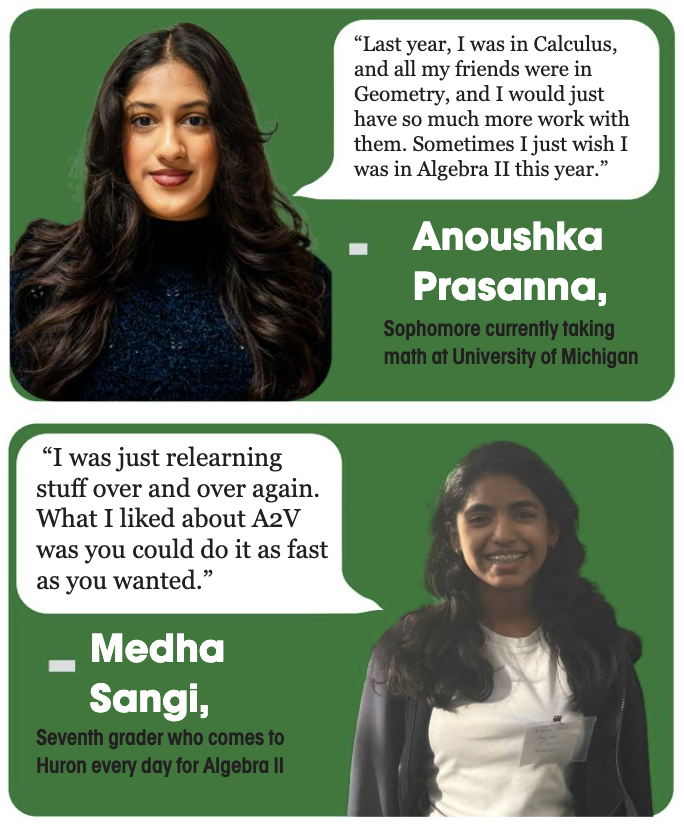
“Before accelerating, math wasn’t hard,” Sangi said. “I was just relearning stuff over and over again. What I liked about A2V was you could do it as fast as you wanted. They didn’t need to spend months on one unit.”
Sophomore Anoushka Prasanna also took A2 Virtual+ math classes, and last year, finished Calculus BC. Now she dual enrolls with University of Michigan to take Linear Algebra. She has a free fourth hour for that class.
It was difficult for her to readjust to in-person learning last year.
“I was struggling to understand a lot of things because they had done a lot of stuff in-person that I hadn’t done,” Prasanna said. “It was rough.”
Prasanna has found that her workload can be hard.
“Last year, I was in Calculus, and all my friends were in Geometry, and I would just have so much more work with them,” she said. “Sometimes I just wish I was in Algebra 2 this year.”
Your contribution will support the student journalists of Huron High School, help us to offer scholarships, cover our annual website hosting costs, and most importantly, allow us to keep recording history.